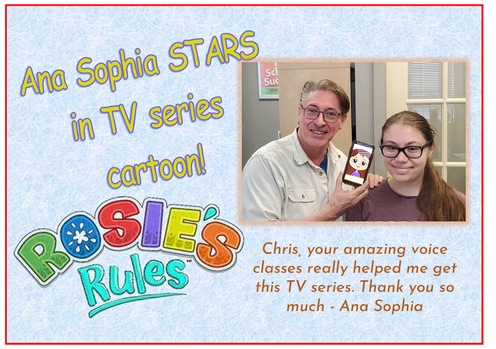
LOOK WHO GOT A VOICE AGENT!!!

Hi Chris -She got the Agent! That’s amazing! Once again thank you for working so hard with us to develop Ella. (Ella's Mother) |
Hi Chris, |
VOICE ACTING COURSE


Worldwide sensation and environmental Activist Rachel Parent working in voice studio with her coach
or 6 years, Christopher Healy
|


|

|
In coaching my Son William for the Franklin auditions, I coached him for two weeks on the scripts and videos they provided. We read through each line, worked on emotions, found the right vocal inflections, along with working on voice syncing to video.
Then we did it again for two full seasons of Arthur. Then when Williams voice was breaking, another one of my clients Jacob got the lead roll of Arthur! Its hard and enjoyable work but he did and so can YOU! |
|
WELCOME TO THE
VOICE-OVER COURSE 10 hours of private coaching: IMPORTANT NOTE: Depending on the students experience or shyness, I can custom these 10 classes to suit your needs.
Each class is 60 minutes in length.
WEEK 1: Working with the basics – relaxing, voice warm-ups, voice energy, performance energy, expressions, visualization, emotions, cold reads. WEEK 2: Using different voice styles, multiple character voices, working with the text and working with equipment. Also exploring accents and dialects. Story / scene / copy breakdown, analysis and story text interpretation. Character research, breakdown and development for e-book characters and storytelling. WEEK 3: Work from week 2 continued with additional working with characters using text for e-books / storytelling continued. WEEK 4: Working with Lighthearted material and phone voice. WEEK 5: Working with in-house instructional video text and documentary text for video (part 1). WEEK 6: Working with documentary text voice over video (part 2) and advanced E-book story telling / characters development. WEEK 7: Cartoon voices, exaggerated expressions, finding your unique voices, working with text alone, then with support images and then using voice over with video. WEEK 8: Defining and exploring cartoon multiple character voices, including voice syncing to video cartoons. Demo reel layout with multiple voices refined. WEEK 9: Advanced voice and text work in radio play, using multiple characters including radio announcer voice, regular voice, and dialects. Demo reel layout with multiple voices refined. WEEK 10: Advanced voice and text work in radio play with multiple characters / dialects continued. Demo reel layout completed. Marketing and branding your voice as a product to agents, independent producers and building your own voice over business from scratch. COST IS $750 + tax paid weekly or $660 + tax if paid all up front. Clients are looking for natural or normal-sounding voices and having a good voice is essential. However, they are also looking for people who can use their voice like a musical instrument. For example, can you sound soft and caring or filled with malice? Can your voice sound inspirational or wise? Can your voice sound like a little cute squeak of a mouse or resonate with a sense of the authoritative? Can you tell a scary story the way you would around a campfire or use dialects and accents? Can you switch deliveries halfway through your sentence? Can you break down your characters and bring them to life? Can you read without sounding rushed, even though you only have 20 second to say the lot? Can you take direction, work with people who make changes constantly and spend hours focused, keeping your energy up and delivering the goods? Of course you are going to say ‘yes” and that’s why you have this course on front of you right now. This course offers you the opportunity to learn to become the full package so you can walk away ready to go. Christopher Healy started his voice / acting training with voice specialist Stephen Costain in Melbourne Australia in 1978 -80. Stephan Costain has been a Voice and acting coach for 35 years as well as an accomplished Actor and Director. He trained a large number of Australian Actors including: Geoffrey Rush, Helen Morse, Petra Yared, Steve Rogers, Alison Bell, Anthony Kiernan, Nicole Dixon, among others. His voice training has encompassed associations with: University of Western Sydney, University of Wollongong, University of Ballarat and The Victorian College of the Arts School of Drama where he was head of voice from 1996 – 2002. Earlier, Stephen operated his own acting School in Melbourne since 1976, once graduating from the Royal Academy of Acting in London England. MORE VOICE OVER INDUSTRY NEWS: 5 Predictions For Voice Overs In 2013: e-Learning, Rates, Social Media & More ... January 2, 2013 By Dan Hurst Voice Talent Nope. Not psychic, just practical. There are a few trends developing in our business that may have an impact on yours. You’ve probably noticed a few also. Please feel free to add to this list! 1. E-Learning Will Continue To Grow This is a no-brainer. As companies figure out the tremendous savings they accrue by training with e-Learning, we’ll continue to see this business grow exponentially. E-Learning is a large part of my business - English and/or Spanish. The industry is growing so fast that there are countless production companies popping up all over the world. 2. Rates Will Continue To Polarize Technology is such that anyone with a computer and a microphone can wade into the voice over business. The start-ups and hobbyists will continue to work for smaller wages simply because they can. Conversely, experienced voice talents who understand how the business works, have great equipment and connections, will continue to grow their businesses. Along with that, their rates will slightly slide higher for a number of reasons: • It’s cheaper in the long run to use good talent that work quickly, accurately, are easy to direct, and don’t need to be micro-managed. • Full-time talents are consistent and can easily make seamless revisions. • The better paying companies want to work with professionals. 3. More Video and Animation Work There are a number of reasons for this. The advertising industry is going through some significant changes. Some of the traditional advertising venues just aren’t as productive as they used to be, not to mention more expensive. As a result, companies are looking for new and innovative ways to tell their stories. Along with that, and similar to the technology issues that allow almost anyone to venture into the voice over business, there are thousands of creative entrepreneurs looking for ways to carve a niche in the industry. Expect to see more and more non-traditional projects that will be used for everything from web postings to email. In addition, more companies and organizations are using in-house production work for on-site marketing and/or training. I came across a very small company that creates a video of every project they do and posts it on their website and YouTube. The lead generation from that effort has been phenomenal for them. Expect more and more of that. 4. Increased Multiple Language Projects Many advertisers are realizing the benefits of niche language marketing. For example, a pocket of ten to twenty thousand language specific buyers could be a gold mine for some businesses. Language and cultural sensitivity are enormous benefits for reaching untapped markets. 5. Erosion of Social Networking ROI For years we’ve been told that you have to be on Twitter, Facebook, LinkedIn, now Pinterest, and a few networks that have lost their allure. Businesses spent, and continue to spend, millions of dollars to develop their place in the electronic netherworld of Social Media. I’ll bet you can’t count on one hand the number of companies that say it’s been worth it. The reason most companies have failed at this is pretty simple. They don’t get it. And they hire people who don’t get it to spend vast amounts of money to not get it. Save your money. Use these networks for what they are designed to be: a place to connect. Social media is basically word-of-mouth advertising. Don’t try to make it something it’s not. Can you find work on these networks? Of course you can. But generally it’s because you’ve made a connection and established a relationship with someone who opens a door for you. That takes time. Not money. So, there you have it. My five predictions for the voice over industry in 2013. -------------------------------------- ABOUT DAN Dan (Daniel Eduardo) Hurst is an experienced bilingual (English and Spanish) voice talent operating out of the Kansas City area. His business now extends internationally, with clients including Sprint, Hallmark, Walmart, Ford, T39 Telemundo and the Kansas City Royals. |
Voice Over Industry Grows to USD $12.3 Billion in 2010
A new report published by Voices.com reveals that the voice and speech industry continues to grow and is currently valued at $12.3 Billion USD. The 2010 Report on the Voice Over Industry is published, highlighting three growing fields in the entertainment industry; audiobooks, mobile gaming and podcasting. Audiobook Highlights: * Audiobook CD sales represent 72 percent of the audio market. * Audiobook downloads grew to 21 percent of the market. Podcasting Highlights: * 150,000 podcasts currently available in the Apple iTunes Store. * 7.1 million people listened to podcasts in 2009, less than 4 percent of US Internet users. * Another 50 million people accessed podcasts and Internet radio on average each month. Edge Studio adds Teen & Kids Voice Over Program to Meet the Industry’s Growing Demand NEW YORK CITY (2012) According to Edge Studio’s production arm, the number of animated features, commercials, cartoons, promos, and ESL projects are expanding. For example Edge Studio needed to audition over 30 boys and girls below the age of 10 for a new cartoon. Get in on the multi-billion dollar
|